
IELTS Exam 2026: Full Form, Fees in India, Syllabus, Pattern, Registration & Preparation
The IELTS exam is one of the most widely accepted English language proficiency tests for individuals planning to study, work, or migrate abroad in 2026. Recognized by universities, employers, and immigration authorities worldwide, IELTS evaluates your English communication skills across four key areas: Listening, Reading, Writing, and Speaking. A strong IELTS score can significantly improve your chances of securing admission to top international institutions and achieving your global career goals.
At APR Overseas, we provide expert IELTS coaching, personalized guidance, and comprehensive study materials to help you achieve your target band score. Whether you are preparing for higher education, employment opportunities, or immigration applications, our experienced trainers support you through every stage of your IELTS journey. This guide covers everything you need to know about IELTS, including exam formats, fees, syllabus, exam pattern, registration process, scoring system, and preparation strategies.
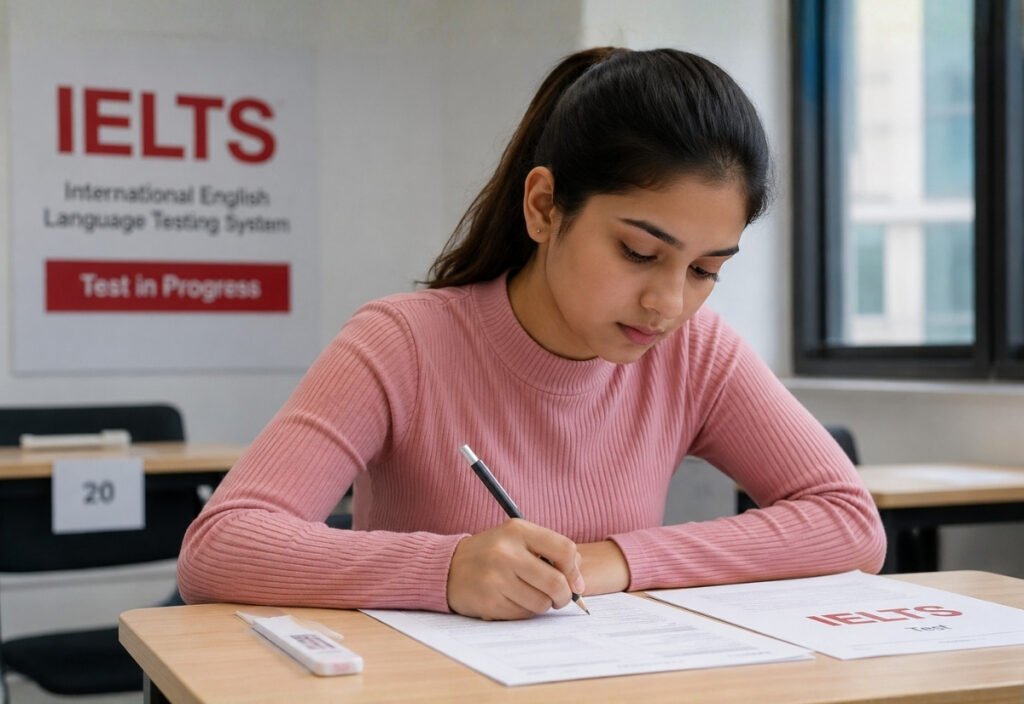
IELTS Exam Details & Highlights
| Particular | Details |
|---|---|
| Exam Name | IELTS |
| Full Form | International English Language Testing System |
| Purpose | Study Abroad, Work Opportunities, PR & Immigration |
| Accepted By | Universities, Employers, and Immigration Authorities Worldwide |
| Conducting Organizations | British Council, IDP IELTS, Cambridge University Press & Assessment |
| Year Introduced | 1980 |
| Test Formats | IELTS Academic, IELTS General Training |
| Test Modes | Computer-Based and Paper-Based |
| Validity | 2 Years |
| Score Range | Band Score 1 to 9 |
| Skills Assessed | Listening, Reading, Writing & Speaking |
| Popular Destinations | UK, Canada, Australia, USA, New Zealand & Ireland |
| Result Time | 3–7 Days (Computer-Based), 13 Days (Paper-Based) |
What is the IELTS Exam?
IELTS (International English Language Testing System) is a globally recognized English proficiency test accepted by universities, employers, and immigration authorities worldwide. It assesses your skills in Listening, Reading, Writing, and Speaking, helping you demonstrate your ability to communicate effectively in English.
Purpose of IELTS
IELTS is required for studying abroad, working overseas, and immigration applications in countries such as the UK, Canada, Australia, the USA, and New Zealand. At APR Overseas, we provide expert IELTS coaching and guidance to help you achieve your target band score and reach your international goals.
Who Should Take IELTS?
IELTS is ideal for individuals who need to demonstrate their English language proficiency for study, work, or immigration purposes. The test is widely accepted by educational institutions, employers, and immigration authorities across the world.
IELTS is recommended for:
- Students planning to pursue Bachelor’s, Master’s, or other higher education programs abroad.
- Professionals seeking international career opportunities in English-speaking countries.
- Individuals applying for permanent residency (PR), work permits, or immigration visas.
Where is IELTS Accepted?
IELTS is accepted by thousands of universities, employers, professional organizations, and government agencies worldwide. It is recognized in popular study and migration destinations, including the United Kingdom, Canada, Australia, the United States, New Zealand, and Ireland.
Since IELTS score requirements vary depending on the institution, course, profession, or visa category, candidates should always check the specific requirements before applying. At APR Overseas, our experts guide you in understanding the required IELTS score for your chosen destination and help you achieve your target band score with confidence.
IELTS Exam Full Form and Test Formats
The IELTS exam is designed to assess a candidate’s English language proficiency for study, work, and immigration purposes. Recognized globally, IELTS helps universities, employers, and immigration authorities evaluate an individual’s ability to communicate effectively in English. The test is available in different formats, allowing candidates to choose the option that best matches their academic, professional, or migration goals.
IELTS Exam Full Form
IELTS stands for International English Language Testing System. It is one of the world’s most trusted English proficiency tests, assessing four key language skills: Listening, Reading, Writing, and Speaking. At APR Overseas, we guide students in selecting the right IELTS test format and provide expert coaching to help them achieve their target band score.

Types of IELTS tests
| Test Type | Best For | Key Difference |
|---|---|---|
| IELTS Academic | Study abroad at universities and colleges | Uses academic reading passages and report-based writing tasks. |
| IELTS General Training | Migration, work, and non-academic purposes | Focuses on everyday English with practical reading and letter-writing tasks. |
| IELTS for UKVI | UK visa and immigration applications | Meets specific UK government security and identification requirements. |
| IELTS Life Skills | UK visa requirements at A1 or B1 level | Tests only Speaking and Listening skills. |
IELTS Delivery Modes
IELTS on Computer
This format is taken at an official IELTS test centre, where candidates complete all sections on a computer. Results are typically available faster than the paper-based test, making it a convenient option for those seeking quicker outcomes.
IELTS on Paper
A traditional testing format in which candidates write their answers by hand. This option is ideal for individuals who are more comfortable with pen-and-paper examinations and prefer a familiar test-taking experience.
IELTS Online
IELTS Online allows candidates to take the test remotely from home. However, acceptance of this format may vary by institution and country. Candidates are advised to verify recognition of IELTS Online with their chosen university, employer, or immigration authority before booking the test.
IELTS Eligibility and Requirements
IELTS is open to candidates from around the world, with basic identification documents required for registration. APR provides guidance on eligibility criteria, age recommendations, registration procedures, and country-specific requirements, helping applicants choose the most suitable test format and complete their booking with confidence.
IELTS Age and Qualification Requirements
IELTS is accessible to candidates from a wide range of educational and professional backgrounds. There are no specific academic qualifications required to take the test, making it suitable for students, graduates, and working professionals alike.
While there is no official minimum age requirement set by IELTS, most test providers recommend that candidates be at least 16 years old. Applicants should also review any country-specific regulations or test centre policies before completing their registration.
Documents Required for IELTS Registration
A valid passport is the primary identification document required for IELTS registration in many countries. In India, candidates must provide their passport number at the time of booking and present the same passport on the test day for identity verification.
As alternative forms of identification are generally not accepted, applicants are encouraged to ensure that their passport is valid and readily available before registering for the examination. APR can assist candidates in understanding the documentation requirements and registration process to help ensure a smooth test booking experience.
Important Considerations Before Booking IELTS
Before registering for the IELTS exam, candidates should ensure that all details entered during the application process are accurate and match the information in their passport. Any discrepancy between the application and identification document may lead to issues on the test day.
Applicants should also select the appropriate test module based on their goals. The IELTS Academic test is generally required for higher education admissions, while IELTS General Training is commonly used for work, migration, or secondary education purposes.
In addition, candidates should choose between the computer-delivered and paper-based test formats according to their comfort level, test-taking preferences, and desired result turnaround time.
IELTS Exam Fees in India for 2026
IELTS exam fees in India for 2026 follow the pricing structure set by official test partners. Standard fees apply to both Academic and General Training tests, whether taken on a computer or paper. Special formats such as IELTS UKVI and IELTS Life Skills have separate fee structures. Candidates should carefully select the correct test type before booking, as fees vary by module and changes after registration may not be permitted.
| IELTS Test Type | Fee (INR) |
|---|---|
| IELTS Academic | 18,000 |
| IELTS General Training | 18,000 |
| IELTS on Computer | 18,000 |
| IELTS on Computer for UKVI | 148,250 |
| IELTS Life Skills (A1 or B1) | 17,000 |
Note: IELTS fees may change from time to time. Please check the official booking website for the most up-to-date fee before completing your registration.
Does the IELTS Exam Fee Vary by City in India?
No, the IELTS exam fee remains the same across all cities and test centres in India. Whether you register for the test in a metropolitan city such as Delhi, Mumbai, Bengaluru, or Chennai, or in a smaller town, you will be charged the same fee for the selected IELTS test type.
The fee structure is standardised nationwide, ensuring fairness and consistency for all test takers. This means candidates can choose a test centre based on convenience, availability, and preferred test dates rather than cost differences. A uniform pricing policy also promotes transparency and equal access to the IELTS exam across the country.
IELTS Exam Pattern 2026
The IELTS exam pattern for 2026 is designed to evaluate a candidate’s ability to use English effectively in academic, professional, and everyday situations. The test assesses four core language skills Listening, Reading, Writing, and Speaking to measure overall English proficiency.
Rather than testing memorised knowledge, IELTS focuses on practical communication abilities, including understanding spoken and written English, expressing ideas clearly, and using the language accurately in real-world contexts. Each section is structured to assess how well candidates can comprehend information, communicate their thoughts, and respond appropriately in different situations.
The table below provides an overview of the IELTS exam pattern 2026, including the sections, duration, and number of questions in each part of the test.
| Section | Duration | What is Assessed | No of Questions |
|---|---|---|---|
| Listening | 30 minutes | Ability to grasp the main points, opinions, and instructions from spoken English in conversations, discussions, and short talks. | 40 |
| Reading | 60 minutes | The ability to read, comprehend, and analyze different kinds of texts, from factual to opinion-based and analytical. | 40 |
| Writing | 60 minutes | The capability to communicate ideas effectively in writing through well-organized responses, including data interpretation and opinion-based writing. | 2 |
| Speaking | 11 to 14 minutes | Face-to-face spoken communication skills covering personal topics, extended speech, and discussion. | 3 |
IELTS Exam Syllabus Overview
The IELTS exam syllabus is not based on a traditional academic curriculum or subject-specific knowledge. Instead, it is designed to assess a candidate’s overall ability to use and understand English effectively in real-world situations. The test evaluates four core language skills—Listening, Reading, Writing, and Speaking—and measures how well candidates can communicate in English for study, work, and migration purposes.
- Listening
The Listening section assesses a candidate’s ability to understand spoken English in both everyday and academic contexts. Test-takers are required to identify key ideas, follow conversations and instructions, understand opinions and attitudes, and locate specific information from a variety of audio recordings featuring different English accents. - Reading
The Reading section evaluates comprehension skills through a range of texts. Candidates must demonstrate their ability to identify main ideas, locate specific details, understand arguments, recognize the writer’s opinions, and interpret the purpose and tone of the content. While the reading materials vary between IELTS Academic and General Training, the focus remains on accurate understanding and interpretation. - Writing
The Writing section measures a candidate’s ability to present ideas clearly and effectively in written English. Candidates are assessed on task achievement, organization and coherence, vocabulary usage, grammatical accuracy, and their ability to develop and support ideas appropriately for the given task. - Speaking
The Speaking section tests spoken communication skills through a face-to-face interview with an examiner. It evaluates fluency, pronunciation, vocabulary range, and grammatical accuracy while encouraging candidates to express opinions, discuss topics, and communicate naturally in English.
Overall, the IELTS syllabus provides a comprehensive assessment of practical English language proficiency, ensuring that candidates are prepared to use English confidently in academic, professional, and everyday environments.
IELTS Registration Process 2026
Registering for the IELTS exam is a straightforward process that can be completed online or through authorized IELTS test centres. Candidates should choose the registration method that best suits their convenience and ensure all details match their passport information.
Offline IELTS Registration
Candidates who prefer offline registration can visit an authorized IELTS test centre and complete the registration process in person. The steps include:
- Visit or contact an authorized IELTS test centre.
- Obtain and complete the IELTS registration form.
- Select your preferred test date, test type, and test format.
- Submit the required identification documents, including a valid passport.
- Pay the applicable IELTS exam fee to confirm your booking.
At APR Overseas, we assist students throughout the IELTS registration process, helping them select the right test type, test date, and centre for a hassle-free experience.
Online IELTS Registration
Online registration is the most convenient and widely used method for booking an IELTS test. Candidates can easily select their preferred test type, date, and location through the official IELTS booking platform.
Follow these simple steps to register online:
- Visit the official IELTS registration website.
- Select your preferred test type (Academic or General Training).
- Choose the test format (Computer-Based or Paper-Based).
- Select your preferred test centre, date, and time slot.
- Enter your personal details exactly as they appear on your passport.
- Upload the required identification documents, if applicable.
- Review all information carefully before proceeding.
- Complete the payment to confirm your booking.
- Save your confirmation email and review the test-day instructions.
At APR Overseas, we assist students with IELTS registration, test selection, and preparation, ensuring a smooth and hassle-free booking experience.
IELTS Test Dates & Slot Booking Timeline 2026
IELTS exams are conducted throughout the year, giving candidates the flexibility to choose a test date that aligns with their study, work, or immigration plans. Computer-based IELTS tests are available on multiple dates each month, while paper-based tests are conducted regularly at authorized test centres across India.
To ensure a smooth application process, candidates are advised to book their IELTS test at least 2–3 months before university admission, visa, or immigration deadlines. Early booking provides greater flexibility in selecting preferred test dates, locations, and allows sufficient time for receiving results or retaking the exam if needed.
At APR Overseas, we help students plan their IELTS timeline strategically to ensure their test scores are available well before application deadlines.
IELTS Test Centres in India
IELTS test centres are located across major cities and regions in India, making it convenient for candidates to take the exam at a location that suits them. Both computer-based and paper-based IELTS tests are conducted at authorized centres equipped with modern facilities and standardized testing environments.
When selecting a test centre, candidates should consider factors such as location, test availability, reporting time, and preferred test format. Major cities often offer more frequent test dates, particularly for computer-based IELTS exams.
Popular IELTS test centre locations include:
- Bengaluru
- Hyderabad
- Delhi NCR
- Mumbai
- Chennai
- Chandigarh
- Ahmedabad
- Kochi
- Pune
- Kolkata
Candidates should check the official IELTS booking platform for the latest test centre availability and exam schedules. At APR Overseas, we assist students in choosing the most suitable test centre and booking their preferred IELTS test date with ease.
IELTS Preparation Strategy
Achieving a high IELTS band score requires a structured preparation plan, consistent practice, and expert guidance. Start by assessing your current English proficiency level and setting a realistic target score based on your study abroad, work, or immigration goals.
To improve performance across all four modules, focus on:
- Listening: Practice daily with different English accents and improve note-taking skills.
- Reading: Enhance speed and accuracy through timed reading exercises and comprehension practice.
- Writing: Develop strong essay-writing techniques, grammar, vocabulary, and task response skills.
- Speaking: Build confidence through regular speaking practice, mock interviews, and cue card sessions.
Regular mock tests, performance evaluations, and feedback sessions are essential for identifying improvement areas and becoming familiar with the actual exam format. At APR Overseas, our expert trainers provide personalized coaching, proven exam strategies, and comprehensive study materials to help students achieve their target IELTS scores with confidence.
IELTS Result Time, Score Report & Validity
IELTS result timelines vary depending on the test format. Candidates taking the computer-based IELTS test typically receive their results within 3–7 days, while paper-based IELTS results are usually available within 13 days. Result notifications are sent to the candidate’s registered email address.
How to Check IELTS Results
- Visit the official IELTS results portal.
- Enter your candidate number, identification details, and date of birth.
- View your section-wise and overall band scores.
- Download or save your score report for future reference.
IELTS Exam Cut-Off
The IELTS cut-off refers to the minimum band score required by universities, employers, professional bodies, or immigration authorities to demonstrate English language proficiency. IELTS assesses candidates across four key skills: Listening, Reading, Writing, and Speaking, with scores ranging from Band 1 to Band 9.
The overall IELTS band score is calculated by averaging the scores from all four sections. Required scores vary depending on the country, university, course, profession, or visa category. Most institutions typically require an overall band score between 6.0 and 7.5, although specific requirements may differ. Candidates should always verify the latest score requirements before submitting their applications.
At APR Overseas, we help students understand the IELTS score requirements for their chosen destination and develop a preparation strategy to achieve their target band score.
Conclusion
IELTS is an important step for students, professionals, and individuals planning to study, work, or migrate abroad. Choosing the right IELTS test type, understanding the exam format, and creating a structured preparation plan can significantly improve your chances of achieving your target band score.
At APR Overseas, we provide expert IELTS coaching, personalized guidance, and comprehensive study abroad support to help you succeed. From test preparation and registration assistance to university admissions and visa guidance, our experienced team is committed to supporting you at every stage of your international journey. Start your IELTS preparation with APR Overseas and take the first step toward achieving your global education and career goals
Frequently Asked Questions (FAQs)
The required IELTS score varies by university, course, and country. Most institutions typically require an overall band score between 6.0 and 7.5.
IELTS scores are valid for 2 years from the test date and can be used for university admissions, employment, and immigration purposes during this period.
Yes. IELTS is available in both Computer-Based and Paper-Based formats. Candidates can choose the option that best suits their preferences.
Computer-Based IELTS results are usually available within 3–7 days, while Paper-Based IELTS results are typically released within 13 days.
Yes. APR Overseas offers expert IELTS coaching, mock tests, speaking practice sessions, study materials, and guidance with IELTS registration, university admissions, and visa applications.