
SAT Exam: Full Form, Pattern, Syllabus, Eligibility, Preparation & Fees in India
The SAT Exam is one of the most widely recognized standardized tests for students planning to pursue undergraduate studies abroad. Conducted by the College Board, the SAT evaluates essential skills in Reading, Writing, and Mathematics that are important for academic success at the university level. Many universities and colleges in the United States, Canada, and other international destinations consider SAT scores during the admissions process, making it a valuable credential for aspiring students.
With the introduction of the Digital SAT, the exam has become shorter, more flexible, and easier to access for students worldwide. This guide covers everything you need to know about the SAT Exam 2026, including its format, eligibility criteria, syllabus, exam fees, registration process, preparation tips, and scoring system. At APR Overseas, we help students understand admission requirements, prepare strategically for the SAT, and build a strong foundation for successful university applications abroad.
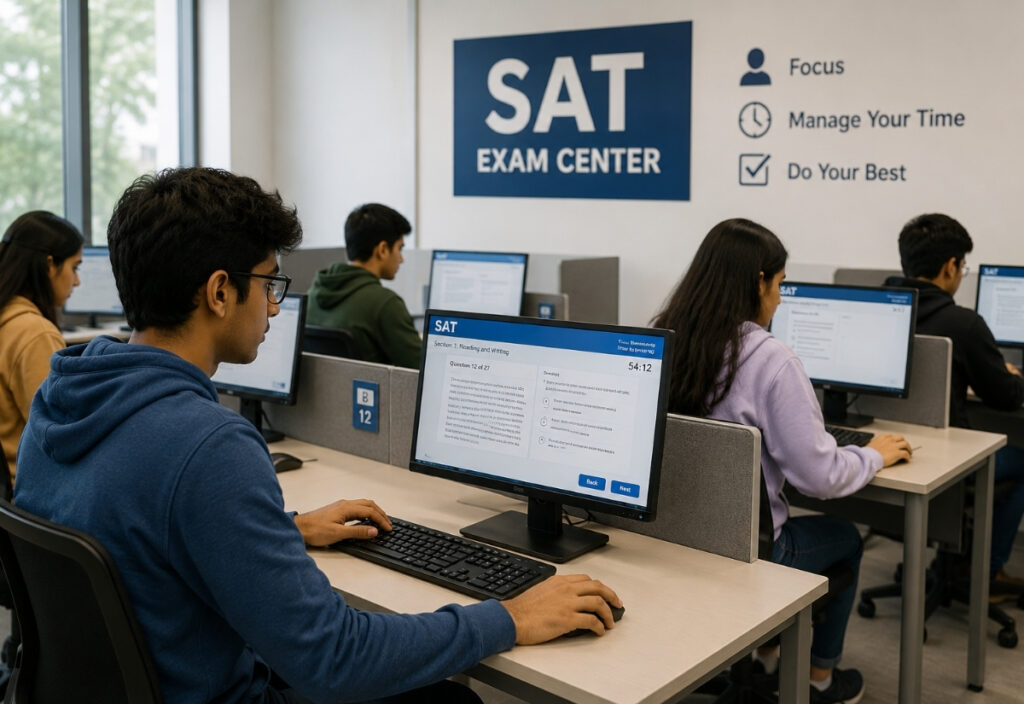
SAT Exam Highlights
| Particulars | Details |
|---|---|
| Exam Name | SAT (Digital) |
| SAT Full Form | Scholastic Assessment Test |
| Conducted By | College Board |
| Official Website | www.collegeboard.org |
| Exam Mode | Online (Digital, computer-based at authorised test centres) |
| Most Popular For | Undergraduate admissions in the USA, Canada, the UK, Italy, and other countries |
| SAT India Country Code | 260 |
| Exam Duration | 2 Hours 14 Minutes + 10-Minute Break |
| Sections | Reading and Writing, Math |
| Question Distribution |
Reading and Writing: 54 Questions (64 Minutes) Math: 44 Questions (70 Minutes) |
| Types of Questions | MCQs and SPR (Student-Produced Responses) |
| Score Range | 400 to 1600 |
| Results Released | Within 13 Days of the SAT Exam Date |
| SAT Score Validity Period | 5 Years |
| SAT Superscoring Available | Yes |
| SAT Exam Fee for Indian Students | ~$130.98 (Approx. ₹11,800–₹12,000) |
| Exam Centres in India | 160+ SAT Test Centres Across 40+ Indian Cities |
What is the SAT Exam?
The SAT is a globally recognized standardized test designed for students seeking admission to undergraduate programs at universities abroad. Conducted by the College Board, the SAT evaluates a student’s readiness for college-level education by assessing essential skills in Reading, Writing, and Mathematics. SAT scores are accepted by thousands of universities across the USA, Canada, the UK, Italy, and several other countries, making it an important component of the international university admission process.
Unlike traditional school examinations that focus heavily on syllabus-based learning, the SAT emphasizes critical thinking, problem-solving, analytical reasoning, and academic skills required for success in higher education. A strong SAT score can strengthen a student’s university application and improve opportunities for admission to leading institutions worldwide.
SAT Exam Full Form
SAT stands for Scholastic Assessment Test. It is one of the most widely accepted admission tests for undergraduate studies abroad. The exam is designed to measure a student’s readiness for college by assessing skills in reading comprehension, written communication, and mathematical reasoning rather than testing memorized subject knowledge.
Today, the Digital SAT offers a shorter, more flexible, and student-friendly testing experience while continuing to evaluate the core academic skills required for university success.
SAT Exam Eligibility 2026
The SAT exam is open to students from diverse educational backgrounds who plan to pursue undergraduate studies abroad. The College Board does not impose strict eligibility requirements, making the SAT accessible to students who are academically prepared and interested in applying to international universities.
SAT Eligibility Criteria
- There is no official minimum or maximum age limit for taking the SAT.
- Most students appear for the SAT during Class 11 or Class 12 while preparing for undergraduate admissions.
- Students can take the exam earlier if they feel academically ready.
- Taking a gap year does not affect SAT eligibility.
- Students applying for undergraduate programs abroad can take the SAT even after completing school.
- Candidates under the age of 17 may need parental or guardian assistance during the registration process.
The flexible eligibility requirements allow students to take the SAT at a time that best aligns with their academic goals and university application plans. At APR Overseas, we help students determine the right time to take the SAT and create a preparation strategy that supports successful admission to top universities worldwide.
SAT Registration Process: Step-by-Step
Registering for the SAT exam is a simple online process through the official College Board website. Students planning to study abroad can complete their registration by following these steps:
1. Create a College Board Account
Visit the official College Board website and create an account using your personal details. Ensure that the information entered matches your identification documents.
2. Select Your Test Date and Test Centre
Choose a suitable SAT exam date and select an available test centre based on your preferred city and location.
3. Upload a Valid Photograph
Upload a recent passport-style photograph that meets the College Board’s identification requirements.
4. Pay the SAT Exam Fee
Complete the registration by paying the applicable SAT exam fee through the available online payment methods.
5. Download Your Confirmation
Once your payment is successful, download and save your SAT registration confirmation. Candidates should keep a copy of this confirmation for future reference and test-day requirements.
At APR Overseas, we assist students with SAT registration, exam planning, and university application guidance to ensure a smooth study abroad journey.
SAT Admission Ticket
After completing SAT registration, candidates must download their SAT admission ticket through the Bluebook™ application. The admission ticket contains important details such as the test date, test centre location, reporting instructions, and candidate information.
Students are advised to complete the Bluebook setup process at least 1–5 days before the exam date to avoid any last-minute issues. Once the setup is complete, download the admission ticket and keep a printed copy ready for the test day. Carrying the required identification documents along with the admission ticket is essential for smooth entry into the examination centre.
SAT Exam Fees in India
The SAT exam fee for Indian students includes the standard registration fee, international charges, and applicable taxes set by the College Board. Understanding the fee structure in advance helps students plan their test registration and avoid any unexpected costs during the booking process.
The total SAT exam cost may vary slightly depending on exchange rates, taxes, and additional services such as test date changes or late registration. Candidates are advised to check the latest fee details before registering to ensure accurate payment and a smooth registration experience.
SAT Registration Fee Structure in India 2026
| Fee Type | Amount (USD) | Approximate Amount (INR) |
|---|---|---|
| SAT Registration (Digital) | USD 68 | ₹6,100 |
| International Registration Fee | USD 43 | ₹3,800 |
| Sales Tax (Approx.) | USD 19.98 | ₹1,800 |
| Total SAT Fee | USD 130.98 | ₹11,700–₹11,900 (Approx.) |
Note: The INR equivalent may vary slightly depending on the prevailing exchange rate, bank charges, and applicable taxes at the time of payment. Candidates are advised to check the latest conversion rates before completing their SAT registration.
SAT Exam Dates 2026
The SAT is conducted multiple times throughout the year, giving students the flexibility to choose a test date that aligns with their undergraduate admission plans. For Indian students planning to study abroad, especially in the USA and other leading study destinations, selecting the right SAT exam date is an important part of the application process.
SAT exam dates are announced by the College Board and are typically scheduled on weekends. Candidates are encouraged to register well before the official registration deadline to secure their preferred test centre and avoid last-minute availability issues. Early registration also provides sufficient time for score reporting and university application submissions.
| Test Date | Registration Deadline | Late Registration & Changes |
|---|---|---|
| August 22, 2026 | August 7, 2026 | August 11, 2026 |
| September 12, 2026 | August 28, 2026 | September 1, 2026 |
| October 3, 2026 | September 18, 2026 | September 22, 2026 |
| November 7, 2026 | October 23, 2026 | October 27, 2026 |
| December 5, 2026 | November 20, 2026 | November 24, 2026 |
Important Note: Students who require a device provided by the College Board should submit their request at least 30 days before the regular registration deadline. Additionally, all SAT registration deadlines close at 11:59 PM Eastern Time (ET), which is approximately 9:29 AM Indian Standard Time (IST) on the following day. Candidates are encouraged to complete their registration well in advance to avoid any last-minute issues.
SAT Exam Centres in India 2026
The SAT exam is conducted at authorized test centres across India, providing students with convenient access to the Digital SAT. Candidates can select a test centre based on their preferred location and seat availability during the registration process. All SAT test centres follow College Board guidelines and are equipped to administer the computer-based exam.
Key Highlights of SAT Test Centres in India
- SAT test centres are available in 40+ cities across India.
- There are 35+ authorized SAT test centres nationwide.
- Major cities include Delhi NCR, Mumbai, Bengaluru, Ahmedabad, Pune, Chennai, Hyderabad, Kolkata, and Amritsar.
- All centres conduct the Digital SAT format.
- Seat availability may vary depending on the test date and city.
- Early registration is recommended to secure a preferred test centre and exam slot.
At APR Overseas, we assist students with SAT registration, test centre selection, exam planning, and university admission guidance, ensuring a smooth and well-organized study abroad journey.
SAT Digital Exam Pattern & Structure 2026
The SAT Exam 2026 is a fully digital, computer-based test designed to evaluate a student’s readiness for undergraduate studies. It consists of two sections Reading & Writing and Math with each section divided into adaptive modules that adjust to a candidate’s performance. The exam lasts 2 hours 14 minutes, includes multiple-choice and student-produced response questions, and is scored on a scale of 400 to 1600, measuring the critical thinking, problem-solving, and academic skills required for university success.
SAT Exam Pattern 2026 (Section-wise)
| SAT Exam Sections | Time Allocated | Number of Questions |
|---|---|---|
| Reading and Writing (RW) | 64 Minutes (2 Modules of 32 Minutes Each) | 54 Questions |
| Math | 70 Minutes (2 Modules of 35 Minutes Each) | 44 Questions |
| Total | 134 Minutes (2 Hours 14 Minutes) + 10-Minute Break | 98 Questions |
Key Features of the Digital SAT 2026 Format
- The SAT is conducted in a fully digital format at authorized test centres.
- The exam uses a computer-adaptive testing system, where question difficulty adjusts based on a student’s performance.
- Both the Reading & Writing and Math sections are divided into two adaptive modules.
- Questions include Multiple-Choice Questions (MCQs) and Student-Produced Responses (SPR).
- There is no negative marking, allowing candidates to attempt all questions without penalty.
- The Digital SAT is designed to be shorter, more flexible, and skill-focused than previous versions.
- The exam evaluates critical thinking, problem-solving, reading, writing, and mathematical reasoning skills required for university success.
Digital SAT Exam Syllabus 2026
Before beginning SAT preparation, students should understand the Digital SAT syllabus to identify the topics covered and create an effective study plan. The SAT is a skill-based examination that evaluates a student’s readiness for undergraduate studies through two core sections: Reading & Writing and Math. The syllabus focuses on critical thinking, problem-solving, comprehension, and analytical reasoning rather than memorization, helping students demonstrate the academic skills required for success at university level.
SAT Reading and Writing Section Syllabus
The Reading and Writing section evaluates a student’s ability to understand written information, analyze ideas, apply grammar rules, and communicate effectively. Questions are based on short passages covering academic, literary, and real-world topics.
Key Topics Covered
- Craft and Structure – Understanding vocabulary in context, analyzing word choice, and evaluating the structure and purpose of passages.
- Information and Ideas – Identifying main ideas, interpreting evidence, drawing conclusions, and analyzing information presented in texts, tables, and graphs.
- Standard English Conventions – Applying grammar, punctuation, sentence structure, and usage rules correctly.
- Expression of Ideas – Improving clarity, organization, and effectiveness of written communication through revision and editing tasks.
SAT Math Section Syllabus
The SAT Math section is designed to assess a student’s mathematical reasoning, problem-solving, and analytical skills required for college-level studies. Questions focus on applying mathematical concepts to real-world and academic situations.
Key Topics Covered
- Algebra – Linear equations, inequalities, functions, and systems of equations.
- Advanced Math – Nonlinear equations, quadratic functions, exponents, and higher-level algebraic concepts.
- Data Analysis and Word Problems – Ratios, percentages, probability, statistics, and interpreting data from tables and graphs.
- Geometry – Area, volume, angles, circles, lines, and coordinate geometry.
- Trigonometry – Trigonometric ratios, right triangles, and basic trigonometric applications.
Understanding the SAT syllabus helps students identify important topics, focus their preparation effectively, and build the skills needed to achieve a competitive score.
SAT Exam Preparation Tips 2026
A successful SAT preparation strategy combines consistent practice, effective time management, and familiarity with the Digital SAT format. Students should focus on strengthening their Reading, Writing, and Math skills while developing confidence through regular practice.
Effective SAT Preparation Tips
- Create a realistic study schedule and allocate time to each SAT section.
- Use official SAT practice tests to understand the exam format and question types.
- Identify weak areas early and spend extra time improving them.
- Take full-length mock tests regularly under timed conditions.
- Review mistakes after every practice test and work on correcting them.
- Develop time-management and question-elimination strategies.
- Practice using the digital testing format to improve exam-day confidence.
- Build strong reading, analytical, and mathematical reasoning skills.
- Stay calm and focused by using stress-management and relaxation techniques.
- Maintain a healthy routine with adequate sleep, exercise, and a positive mindset.
At APR Overseas, we help students create personalized SAT preparation plans, understand university admission requirements, and maximize their chances of achieving competitive SAT scores for top international universities.
SAT Exam Scoring and Results 2026
The SAT is scored on a scale of 400 to 1600, with Reading & Writing and Math each contributing up to 800 points. The final SAT score is calculated by combining the scores from both sections.
Students who take the SAT can typically access their results within 13 days after the test date through their College Board account. SAT scores are accepted by universities worldwide, and the required score varies depending on the institution, course, and level of competition. Higher-ranked universities generally expect stronger SAT scores, while admission requirements differ across programs and countries.
Understanding university-specific score requirements can help students set realistic target scores and create an effective preparation strategy for successful undergraduate admissions abroad.
Steps to Check SAT Results 2026
Students can access their SAT results online through their College Board account by following these simple steps:
- Log in to the official SAT Student Score Portal using your registered College Board credentials.
- View your latest SAT score on the dashboard once the results are released.
- Select the score report to access detailed section-wise performance and score insights.
- Download or save the official score report for future reference.
- Send your SAT scores directly to universities through your College Board account, if required.
SAT results are typically released within 13 days of the test date, allowing students to plan their university applications efficiently.
SAT Cut-Off 2026
There is no universal SAT cut-off score for university admissions, as institutions evaluate applications using multiple factors such as academic performance, extracurricular achievements, personal statements, recommendation letters, and SAT scores. Many universities have also adopted test-optional policies, allowing students to apply without submitting SAT scores.
In general, highly competitive universities often admit students with SAT scores ranging between 1300 and 1500+, while many institutions accept scores around 1050 to 1300, depending on the course and admission requirements. However, SAT scores are only one part of the application process, and students with strong academic and extracurricular profiles may still be considered even if their scores fall outside these ranges.
Before applying, candidates should always review the latest SAT score requirements of their chosen universities to understand the expectations for their preferred program and admission cycle.
How to Send SAT Scores to Universities
After taking the SAT, students can choose which universities will receive their scores based on individual admission requirements. The College Board allows candidates to send up to four score reports free of charge if selected within the designated score-reporting period.
If students wish to send scores after the free reporting window closes, an additional fee is charged for each score report. To send scores, candidates simply need to log in to their College Board account, select their preferred universities, and submit the score reports electronically.
For universities that accept SAT Superscoring, students can benefit by submitting their highest section scores from multiple test attempts, helping present the strongest possible application profile. Candidates should always review the score-reporting policies of their chosen universities before sending their results.
Conclusion
The SAT exam is an important milestone for students planning to pursue undergraduate studies abroad. As a globally recognized and skill-based assessment, the Digital SAT evaluates critical thinking, problem-solving, reading, writing, and mathematical reasoning skills that universities value during the admissions process.
Understanding the SAT format, syllabus, scoring system, registration process, and score requirements can help students prepare more effectively and approach the exam with confidence. Starting preparation early, practicing consistently, and setting realistic score goals can significantly improve performance and strengthen university applications.
At APR Overseas, we provide expert guidance on SAT preparation, university selection, application planning, and admission requirements, helping students make informed decisions and successfully achieve their study abroad goals.
Frequently Asked Questions (FAQs)
The SAT is a standardized test used by universities and colleges to assess a student's readiness for undergraduate studies. SAT scores are accepted by institutions in the USA, Canada, the UK, and several other countries.
There are no official age or academic qualification requirements for the SAT. Most students take the exam during Class 11 or Class 12 while preparing for undergraduate admissions abroad.
The SAT is scored on a scale of 400 to 1600, with Reading & Writing and Math each contributing up to 800 points.
SAT results are typically released within 13 days after the test date and can be accessed through the student's College Board account.
Yes. The Digital SAT is shorter, fully computer-based, and uses an adaptive testing format. It focuses on critical thinking, problem-solving, reading, writing, and mathematical reasoning skills rather than memorization.